
Trump herkozen, gevolgen en follow up #2
Moderators: Essie73, NadjaNadja, Muiz, Telpeva, ynskek, Ladybird, Polly

- DubbelFun
-

- Berichten: 94076
- Geregistreerd: 12-04-01
- Woonplaats: 1 km van het midden van Nederland
Re: Trump herkozen, gevolgen en follow up #2
 Geplaatst: 03-01-26 18:13
- Benzz
- Berichten: 6698
- Geregistreerd: 10-02-19
Geplaatst: 03-01-26 18:15
- DubbelFun
-
- Berichten: 94076
- Geregistreerd: 12-04-01
- Woonplaats: 1 km van het midden van Nederland
Re: Trump herkozen, gevolgen en follow up #2
Geplaatst: 03-01-26 18:16
- _San87_
- BKB 2024 winnaar 2D
-

- Berichten: 49225
- Geregistreerd: 18-05-09
- Woonplaats: Het bos
Geplaatst: 03-01-26 18:19
DubbelFun schreef:Het was in een militair complex, dus dat verwacht ik niet daar.
Volgens de Venezolaanse officials zijn er burgerdoden gevallen:
Citaat:Volgens de Venezolaanse defensieminister Vladimir Padrino López werden onder andere woonwijken getroffen in het gebied rond Fuerte Tiuna, een groot militair complex in het zuiden van Caracas. Daar is ook het hoofdkwartier van het Venezolaanse ministerie van Defensie gevestigd.
https://www.haarlemsdagblad.nl/buitenla ... 67984.html
- DubbelFun
-
- Berichten: 94076
- Geregistreerd: 12-04-01
- Woonplaats: 1 km van het midden van Nederland

- Lieser
- Berichten: 4156
- Geregistreerd: 15-03-21
- Woonplaats: Voorschoten
Geplaatst: 03-01-26 18:39
Benzz schreef:Lieser schreef:Ik ben benieuwd hoe Rutte hierop gaat reageren. Tot nu toe was Trump zijn Nieuwe Beste Vriend (althans in het openbaar).
Die hoeft er niet op te reageren, Venezuela is geen NAVO land.
Oekraïne ook niet, maar daar liet Rutte zich tot nu toe niet door tegenhouden.
- _San87_
- BKB 2024 winnaar 2D
-
- Berichten: 49225
- Geregistreerd: 18-05-09
- Woonplaats: Het bos
Geplaatst: 03-01-26 18:42
DubbelFun schreef:Ik zie dat liever door een Reuter oid naar buiten gebracht als het Haarlems Dagblad.
Is nu.nl wel acceptabel?
https://www.nu.nl/buitenland/6381419/li ... sland.html
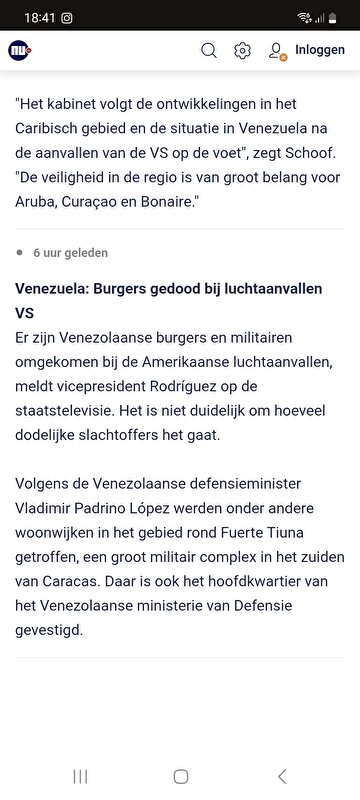
Nu meldt Venezuela het zelf, dus of het écht waar is, dat weet ik niet. Maar er wordt wel over gesproken door de autoriteiten daar.

- Benzz
- Berichten: 6698
- Geregistreerd: 10-02-19
Geplaatst: 03-01-26 18:45
Europa is natuurlijk weer niets in dit. Misschien gelukkig maar.
- Benzz
- Berichten: 6698
- Geregistreerd: 10-02-19
Geplaatst: 03-01-26 18:45
Babootje schreef:VS laat weten: ik ga mn gang binnen mijn invoedssfeer Zuid Amerika. China gaat zn gang maar in Taiwan en Rusland in Oekraine, ligt voor de hand. De wereld verdelen…
Weet ik niet, zowel China als Rusland hebben behoorlijk wat economische belangen in Venezuela.
- _San87_
- BKB 2024 winnaar 2D
-
- Berichten: 49225
- Geregistreerd: 18-05-09
- Woonplaats: Het bos
- DubbelFun
-
- Berichten: 94076
- Geregistreerd: 12-04-01
- Woonplaats: 1 km van het midden van Nederland
Geplaatst: 03-01-26 18:48
@Babootje: dat heb ik hem al eerder horen zeggen en Poetin en Kim zijn het ook vast met hem eens.
Rutte en het merendeel van de Europese leiders zitten in een moeilijke positie; ze kunnen het niet eens zijn met wat Trump gedaan heeft, maar zien Maduro ook liever gaan dan komen.
En verder moet Europa zijn eigen plan gaan trekken om Poetin buiten de deur te houden, nu meer dan ooit!
- tamary
-

- Berichten: 31077
- Geregistreerd: 19-06-02
- Woonplaats: Drenthe
Geplaatst: 03-01-26 18:52
En het aanbod van olie wereldwijd is nog altijd hoger dan de vraag (iets met onderweg naar economische crisis), dan is enkel de export vanuit Venezuela afknijpen kennelijk niet genoeg om prijs op te jagen.
- Lieser
- Berichten: 4156
- Geregistreerd: 15-03-21
- Woonplaats: Voorschoten
Geplaatst: 03-01-26 18:57
Benzz schreef:Lieser schreef:[
Oekraïne ook niet, maar daar liet Rutte zich tot nu toe niet door tegenhouden.
Maar wel een onderdeel van Europa en destijds was Rutte nog MP.
Destijds? Rutte liet zich in oktober 2025 nog uit over de fantastische manier waarop Trump zich met Oekraïne bemoeide. Toen zat hij al een jaar bij de Navo.
En begin december 2025 opnieuw.
Wel bij blijven hoor ...
- DubbelFun
-
- Berichten: 94076
- Geregistreerd: 12-04-01
- Woonplaats: 1 km van het midden van Nederland
Re: Trump herkozen, gevolgen en follow up #2
Geplaatst: 03-01-26 19:04
- Benzz
- Berichten: 6698
- Geregistreerd: 10-02-19
Geplaatst: 03-01-26 19:06
tamary schreef:Qua olie heeft de VS een prijs van 60 dollar of hoger / barrel nodig gezien hun productiekosten in de VS zelf. Kan heel goed dat Venezuela lagere productie kosten heeft en dan is dat de andere manier om genoeg te hebben voor eigen gebruik zonder dat de eigen bedrijven failliet gaan wegens te lage verkoopprijs. Hij moet tenslotte toch op de een of andere manier de kosten van levensonderhoud naar beneden krijgen...
En het aanbod van olie wereldwijd is nog altijd hoger dan de vraag (iets met onderweg naar economische crisis), dan is enkel de export vanuit Venezuela afknijpen kennelijk niet genoeg om prijs op te jagen.
Het idee dat de VS Venezuela nodig heeft voor “goedkope olie” klopt niet, omdat het uitgaat van een verkeerde vergelijking. Ja, Amerikaanse shale heeft een break-even rond de 60 dollar per vat, maar dat betekent niet dat Venezuela goedkoper produceert. Integendeel: Venezuela heeft weliswaar enorme reserves, maar de productie is door jarenlange verwaarlozing, corruptie en sancties zo ingestort dat de operationele kosten per vat juist hoger liggen dan in de VS. Ultra‑zware Orinoco‑olie is technisch moeilijk, duur om te verwerken en vereist verdunningsmiddelen die Venezuela zelf niet eens meer kan produceren.
Met andere woorden: er is geen goedkope Venezolaanse olie om de Amerikaanse markt te overspoelen. Het land kan nauwelijks produceren, laat staan tegen lage kosten.
Daar komt bij dat de VS helemaal geen belang heeft bij lage olieprijzen. Een prijs onder de 60 dollar zou de Amerikaanse shale‑sector, een van de grootste werkgevers en investeerders in de energiemarkt, direct in de problemen brengen. Trump gaat zijn eigen binnenlandse industrie niet ondermijnen door goedkope Venezolaanse olie binnen te halen. Dat is economisch en politiek onlogisch.
Bovendien is het wereldwijde overschot aan olie geen structureel gegeven, maar een tijdelijk effect van OPEC+‑besluiten en economische vertraging. Zodra de vraag aantrekt of OPEC+ de kraan dichtdraait, verdwijnt dat overschot. Venezuela heeft daar nauwelijks invloed op, omdat het simpelweg te weinig produceert om de wereldmarkt te bewegen.
De Amerikaanse actie in Venezuela draait denk ik niet om prijsmanipulatie of goedkope import, maar om geopolitieke herpositionering: het uitschakelen van Russische en Chinese invloed in Latijns‑Amerika, het veiligstellen van toekomstige productiecapaciteit, en het creëren van een stabieler regime dat op termijn weer investeerbaar is. Het gaat om macht, niet om korting.
- Benzz
- Berichten: 6698
- Geregistreerd: 10-02-19
Geplaatst: 03-01-26 19:11
Lieser schreef:Destijds? Rutte liet zich in oktober 2025 nog uit over de fantastische manier waarop Trump zich met Oekraïne bemoeide. Toen zat hij al een jaar bij de Navo.
En begin december 2025 opnieuw.
Wel bij blijven hoor ...
Je mist mijn punt een beetje. Ik had het over Venezuela en de vraag of Nederland of de NAVO daar überhaupt een rol heeft. Dat Rutte zich in 2025 uitsprak over Oekraïne klopt, maar dat deed hij als NAVO‑secretaris‑generaal, over een dossier dat wél direct onder de NAVO valt. Dat is precies waarom mijn opmerking ‘geen NAVO‑land’ relevant is: Venezuela is géén NAVO‑dossier, dus je kunt niet verwachten dat hij daar dezelfde zichtbaarheid of uitspraken over heeft. Je vergelijkt twee totaal verschillende verantwoordelijkheden.
- tamary
-
- Berichten: 31077
- Geregistreerd: 19-06-02
- Woonplaats: Drenthe
Geplaatst: 03-01-26 21:10
Citaat:Today, there is worrying news from Africa.
Here, Russia started massively supplying weapons to Madagascar, stating on the surface that they just sought to maintain positive ties with friendly countries. However, the head of Russia’s clandestine operations unit himself was put in charge of personally overseeing its delivery, indicating that Russia’s intentions go much deeper than one might think.
Bloomberg reports that Russia initiated arms deliveries to Madagascar’s military-led government. On December 20, a Russian Air Force aircraft reportedly landed near Antananarivo carrying 40 Russian military personnel and 43 crates of weapons. The shipment was described as military equipment intended to strengthen the operational capabilities of Madagascar’s armed forces. Although such deliveries are consistent with Russia’s broader activities in Africa, the operation is notable because the deputy head of the GRU, the commander of the notorious unit 29-1-55, was tasked to represent Russia and personally hand over the weapon crates, indicating a much higher level of strategic involvement than would seem on the surface.
Unit 29-1-55 is a covert GRU Russian military intelligence formation tasked with conducting clandestine offensive operations abroad, predominantly linked to assassinations and activities intended to destabilize European states. The unit is commanded by Major General Andrey Vladimirovich Averyanov, who has notably assumed effective control over former Wagner Group operations in Africa after the mercenary group fell out of favor.
Russia’s stated objective in Madagascar is to provide training to the military junta’s forces and pursue intergovernmental cooperation. The layer beneath this surface narrative, however, is revealed by Averyanov’s presence. Russia’s real goal is to cultivate a loyal partner in the strategically significant Indian Ocean region, expand its diplomatic leverage, and erode traditional Western footholds. Madagascar’s position in the Indian Ocean grants it notable geopolitical importance for its sea trade lanes and broader regional dynamics. Notably, all east-to-west maritime trade goes through the Suez Canal or around Africa. When the Suez Canal is inaccessible due to conflict or other disruptions, most, if not all, maritime traffic diverts around the Cape of Good Hope, transiting along Africa’s eastern coast and through the Mozambique Channel between Mozambique and Madagascar. An additional prize for Russia is Madagascar’s significant natural resources, including graphite, where the country ranks among the world’s leading producers, as well as nickel, cobalt, rare earth elements, and precious stones such as sapphires, rubies, and other gemstones.
These developments could pose strategic challenges for Western states should Russia gain the upper hand in the recently turbulent country. Primarily, Russia aims to expand its influence to safeguard its own trade routes, including those used by its shadow fleet vessels. If Ukraine or its western allies manage to continue their campaign and effectively block sea trade routes through the Mediterranean, Russia would require safe passage and friendly ports along an alternative trade route that would form near Madagascar. It’s important to understand that should Russia push Madagascar over the tipping point, it would create the long-term potential to exert leverage over the trade routes of other states. Madagascar would enable Russia to have leverage over Western rivals, controlling half of the trade between Europe and Asia.
Following Gen-Z protests in October, the military junta has pledged to hold elections and take a non-aligned status in world politics. Western powers and the African Union have halted cooperation with Madagascar, pending the validity of the country’s return to democracy. As such, Russia is taking advantage of its indifferent stance on its allies’ democracy and gaining a head start in the race to secure its position, and the powerful influence it can project from the recently turbulent country.
Overall, Madagascar is another part of the African continent, where Russian operations are ongoing to carve out their sphere of influence and deny access to Western powers. Russia’s usual playbook of arms deliveries and security to gain influence is in play in Madagascar as well. The military junta finds an ally in Russia, regardless of the return of democratic practices, in exchange for...

 de wereld is vergeven van de machtsgeile eikels
 - Cowboy55
- Berichten: 9374
- Geregistreerd: 11-10-05
Re: Trump herkozen, gevolgen en follow up #2
Geplaatst: 03-01-26 22:52
 Hoe kan een land zo afzakken……
 - IMANDRA
-

- Berichten: 11007
- Geregistreerd: 30-05-10
- Woonplaats: Silva Ducis
Geplaatst: 03-01-26 23:56
Cowboy55 schreef:Ik zit op Netflix te kijken naar 6 triple 8. Zwarte vrouwen in WW2. Zet dat eens af tegen de VS van Trump. Jezus……
Nou ja die werden daar ook maar heengestuurd omdat de machtige witte Amerikaanse mannen dachten dat ze nergens goed voor waren
